We’ve improved it to help you find information faster
When you connect to our network, you’re connecting to a power network which is 100% locally owned and operated, with 34,000 residential and commercial customers across South Canterbury. We’re here to keep your lights on and connect to you to the world.
For electricity and solar connections
Getting a new electricity connection or making changes to an existing one follows five key steps. This applies whether you’re connecting a new home, upgrading an existing connection, installing solar (also called distributed generation) or working on a larger project like a development or high-capacity connection.
While the overall process is the same, the level of detail, cost and timeframes will vary depending on whether your application is standard or more complex. See an outline of this process below.
A complex application is required for larger or more technical connections (usually over 69kW) or where a standard connection isn’t suitable. This includes:
category 2 to 5 metering (eg 69kW and above)
large commercial or industrial customer with a large load
large-scale generation like solar, wind or battery
subdivisions or high-density housing developments
projects that may require network upgrades or new equipment
larger upgrades or changes to an existing connection
These connections usually:
involve more detailed planning
require a tailored quote
may need power outages to complete the work
require technical assessment and network studies
The nature of this work would typically require quoting and a higher level of work and/or network outage planning from us.
More info on complex connections
Note: If a new meter or connection point is needed, your electricity retailer (who you pay your power bill to) will organise this and we’ll work together to get you connected.
Steps to get connected
1. Enquire & discuss
Understand your options, the process, timelines and application costs with your service providers (electrician, livening agent, network-approved contractor and retailer) and our web self-service tools.
2. Apply & explore
Apply for new connections, or engage your service provider, who will apply for your connection for you. This is required if you are upgrading your existing connection, installing solar or need power to your boundary. We will Source Editorreview your application.
3. Design & approve
We will work with the service provider to design the solution, ensuring it meets your requirements, then review and approve the proposed plan before proceeding.
4. Deliver & build
The approved service provider(s) will deliver the agreed solution.
5. Connect & complete
When the connection is ready, inspection and livening are needed. Then you or your electrician can contact your retailer for metering to be installed by the livening agent.
Roles and responsibilities
Connection pricing and policies
We aim to make connecting to our network as simple, fair, and transparent as possible. Your quote is based on the lowest-cost technically acceptable solution that safely and reliably connects you to our network, so you only pay for the work needed to connect your property.
If you'd like additional services, such as extra capacity or underground connections, these can be included as optional enhancements and priced separately. We can also discuss flexible connection options, which may reduce connection costs for example, you may be able to agree to manage or reduce your electricity demand during peak network periods.
Most residential and small business connections are covered by our Standard connection charges. Larger or more complex projects are individually designed and priced.
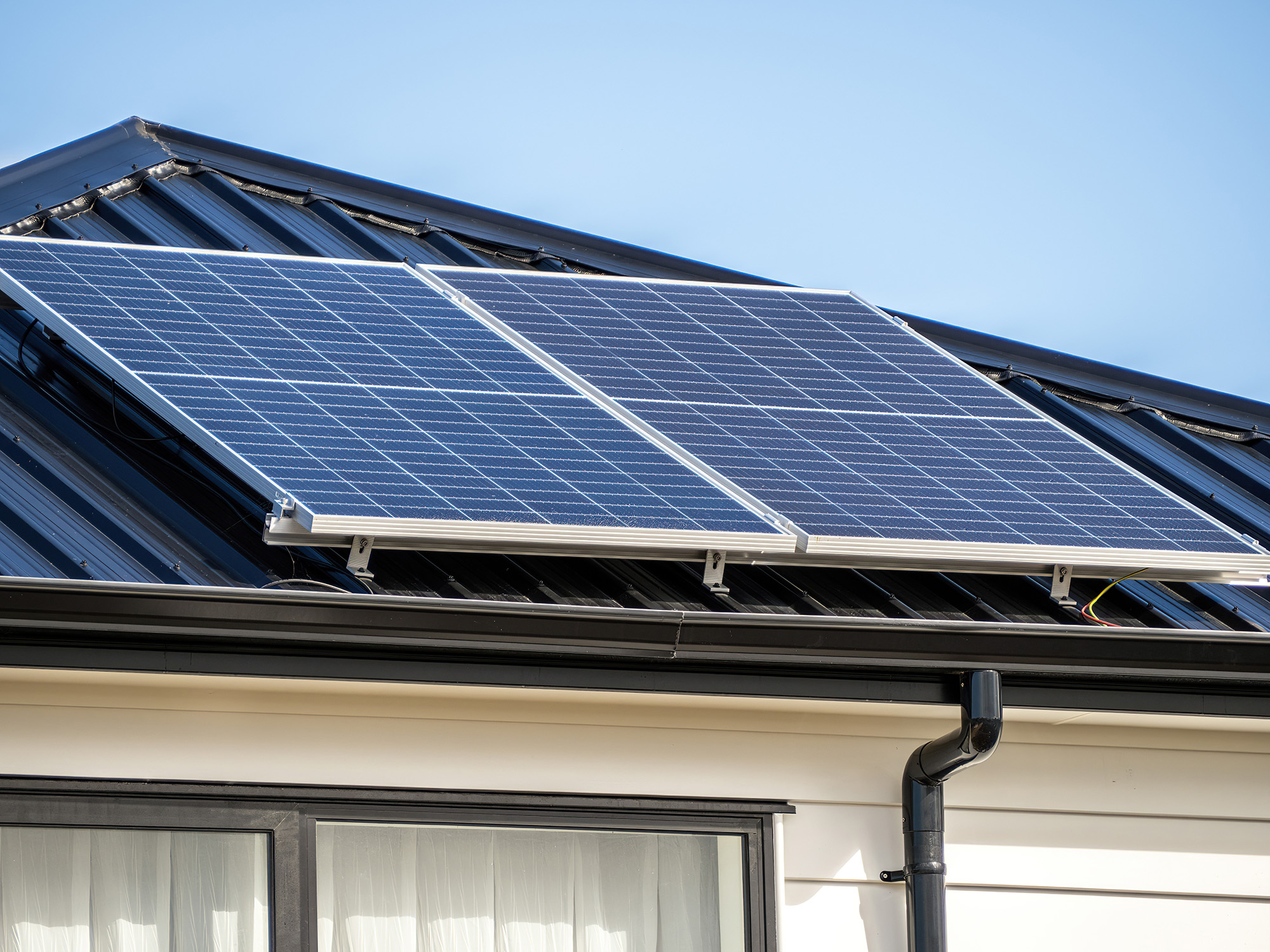
Solar power for homes and small businesses
Your location or conditions may suit generating your own energy – such as lots of sun or wind, or a running stream of water. Generating your own electricity can contribute towards better sustainability. You may even generate more electricity than you use, which you can store in a battery or sell back to an energy retailer through the grid. Alpine Energy has a 10kW export limit per residential connection.
You’ll need to contact an energy retailer (who you pay your power bill to) to set up an account if you’re not already a customer. You can find a list of retailers at Powerswitch or Billy. If you’re already an existing or recent customer of an energy retailer, you’ll need to contact them to advise the new address you’d like to be connected to.
Please apply for a new electricity connection here. You can ask your electrician to assist you with completing the form or have them complete the form on your behalf. You’ll need to pay the application fee when you submit the form.
Before you get started, you’ll need:
Contact details for the person who will pay for the work
Your electricians contact details
The electricity account holders’ details
Your ICP (installation control point) number (if this is an existing connection)
Your electricity retailer and account number
If power to the boundary is required, an Alpine Energy Approved Contractor needs to undertake the work.
Other than your contact details, there are several pieces of information that you will require to get a power installed to your property and include in your (or your service providers) enquiry or application. For standard connections, these are typically:
Property address. This is the address of the property where you would like the service installed.
Lot, Rapid or Deposited Plan (DP) number. If you don’t have an address yet, then a Lot or DP number will be fine.
Pole number of the closest power pole. If you can see a power pole nearby, there will be a pole number on it. Take that number down, or better still, take a photo of it for reference.
What are you going to be powering? We need to know if this is for a residential dwelling or a commercial operation. This will have an impact on the design of your power requirements.
Your electricity retailer and the retail account holder’s details.
We’ll assess your connection requirements and for standard applications we will get back to you within 10 working days of your application, to let you know if:
There’s a suitable connection available, and you can proceed, or
Further work is required to make a connection available, or
Further network design and construction work is required on Alpine Energy’s network to enable your connection
Once you’re able to proceed, we’ll issue you an installation control point (ICP) number. You can contact your retailer to arrange metering and quote this ICP number. We’ll also supply this ICP number to your retailer. When your electrician is ready to connect your electricity, they can arrange an appointment with your chosen metering and connection contractor to install the meter and complete the connection.
If power is available at the boundary, this service takes around 10 –20 working days once notified by your electrician that the connection is ready. If your request is urgent, please get in touch with us.
Network design and construction (where required):
If further network design/works are required, we’ll provide you with a quote, and you’ll need to cover the costs of these works.
Work can commence once you’ve accepted our quote and made payment.
A Network Enquiry is for customers who are still in the early planning stage and want advice on network capacity, connection options, or the process before submitting a formal application.
A Network Connection or Alteration Request is a formal application used when you're ready to connect to the network or make changes to an existing connection, such as a new connection, capacity upgrade, switchboard upgrade, meter relocation, or overhead-to-underground conversion.
The cost of a new connection depends on the type and complexity of the work required.
For most standard connections, application fees typically range from $500 to $1,100, plus an ICP Establishment Fee of $300. More complex connections are individually assessed and priced based on the design, equipment, network capacity, and construction work required.
For solar installations (also called distributed generation), application fees are:
Up to 10kW (residential): $160
11kW to 100kW: $500
101kW to 1MW: $1,000
Over 1MW: $5,000
Once we've assessed your requirements, we'll provide a quote for the connection work. You can also obtain quotes from more than one Alpine Energy-approved contractor, allowing you to compare prices before proceeding.
Your electrician can arrange the installation of your private service line or cable. Once the work is complete and ready for connection, Alpine Energy-approved contractors will inspect the installation, install the meter, connect the property to the network, and liven the supply.
Your electrician will certify the work and coordinate the inspection and connection process. Once the connection has been completed and energised, your electricity retailer will begin billing you for electricity use.
New connections and increases in electricity demand can require additional capacity on the network. In some cases, this may mean upgrades are needed to infrastructure such as transformers, cables, or power lines.
Your connection quote will include the cost of the minimum works needed to connect or accommodate your increased demand, as well as any optional enhancements you request. Where a capacity upgrade directly results from your connection or increased load, a contribution towards network upgrade costs may apply.
For more information on how connection and capacity upgrade charges are calculated, see our Connection Pricing Policy.
No. If your connection requires upgrades to the network or the installation of Alpine Energy equipment, you may need to contribute to the cost. However, any Alpine Energy-owned equipment remains our property, and we are responsible for its operation and maintenance.
You remain responsible for maintaining any equipment you own, such as the service line connecting your building to the network.
We have a different connection process for complex connections, which involves more details and ensures we will have capacity on the network to support your needs. Learn more about complex connections.
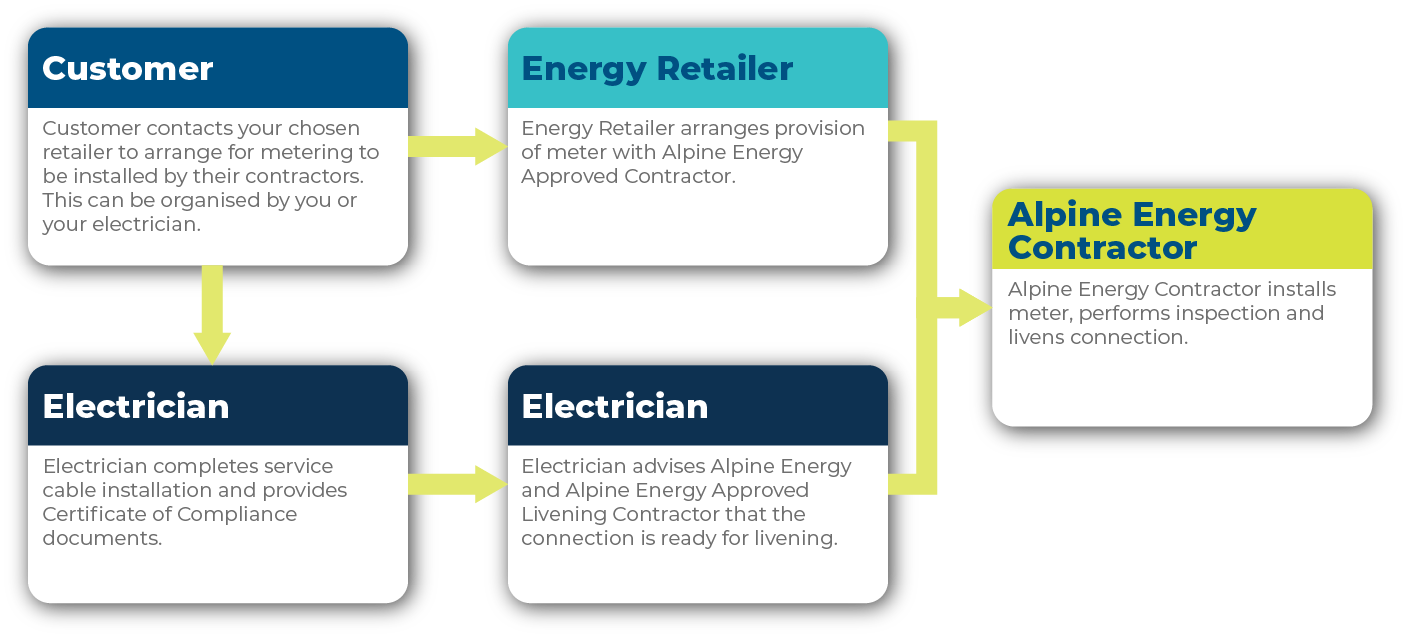
Connecting your property to the network involves several parties, each with a specific role:
You (or your electrician) arrange metering with your chosen electricity retailer.
Your electrician installs the service cable and completes the required compliance certification.
Your electricity retailer arranges meter installation through an Alpine Energy-approved contractor.
Alpine Energy-approved contractors inspect the installation, install the meter, connect the property to the network, and liven the supply once all requirements have been met.
Once the connection has been energised, your electricity retailer will begin billing you for electricity usage.
This process helps ensure your connection is completed safely, meets all regulatory requirements, and is ready for ongoing electricity supply.
For further advice, please contact our Key Account Manager team with any questions you have regarding the connections process – we’re here to help. Our Key Account Managers are divided by regions in South Canterbury, so have the address handy when you call 0800 66 11 77.